Showing posts with label Japan. Show all posts

Thursday, March 22, 2007

Back to Tokyo

March 20

Lunch was at a winery called Cave d’Occi in the warmest part of Niigata prefecture. The grapes were mostly traditional Bordeaux and Burgundy varietals, although the winemaker had been planting some Italian and Spanish grapes in recent years. That went with a lunch that was basically regional Italian, if you treated Niigata as a region of Italy.
Both Japanese and Italian cuisines put a heavy stress on the use of local, seasonal stuff, so it’s really no stretch to take the ingredients that are available in Japan — octopus and baby mackerel, say — and assemble them with an Italian sensibility. And that's just what they did.
Dessert was a cassis, strawberry and vanilla parfait accompanied by strawberry sorbet and, for Japanese content, cherry-blossom jelly.
We also stopped by Echigo, home of Japan’s first microbrewery. There we sampled a pale ale, an amber and a weissbier as well as the only beer Echigo exports to the United States. That was a light lager sold in Japanese an Korean restaurants for $12. Cool, big bottle, all in Japanese.
After a couple more stops, to look at lacquerware and possibly buy other things — Naren picked up some bar implements, I just looked around — we hopped back on the shinkansen to head back to Tokyo.
During the train ride back, Suimi Fujiwara, a representative from JR and a companion of ours for the entire trip, handed out beer, sake and preserved Murakami salmon, sliced in strips, and, using Akiko as an interpreter, quizzed us about the trip, asking us to evaluate it. We gave them high praise, although I suggested that perhaps we didn’t need to dine on the floor quite so much — it’s a nice tradition, but it hurts. I also said it would be nice to see where the Murakami cattle was being raised and to visit other production facilities.
Back at the Shinagawa Prince hotel, we took an hour to decompress and then headed to the Roppongi neighborhood.
Akiko wanted us first to stop at Roppongi Hills, a large commercial and residential complex with many restaurants and shops. We popped our heads into L'Atelier de Joël Robuchon. We wandered around the bakeshop and no one said a word. That was in sharp contrast to what I thought was the universal practice in Japan of greeting everyone who walked into your establishment with a warm, hearty welcome. I asked Akiko if it were true that even at McDonald’s in Japan you were met with such a greeting.
She said it was. And I know that anyone who walks into a shop in France is greeted with a warm “bonjour,” and you’re supposed to say “au revoir” when you leave. So it’s not like the Atelier staff was just following French custom. They seemed just to be rude.
We ended up eating at an izakaya called Gonpachi. Naren wanted to eat there, because friends of his had said it was good and because it had been in Kill Bill, so it would possibly be touristy, but also possibly cool.
The décor was that of an oversized, two-story Japanese tavern, just over-the-top enough to be appropriate for Kill Bill, yet with a hint of bar & grill mixed in. The servers reminded me of southern Californians.
I was in the mood for vegetables and Naren was in the mood for meat, so between with us we basically ordered the entire menu. Akiko and Fujiwara-san seemed fine with that.
We lingered until after the subways had stopped and resolved to stay out until Tsukiji, the wholesale fish market, opened. Naren wanted to see the tuna auctions and that was fine with me.
From Gonpachi we went to a bar named Mangin. It was a cool spot run by kids who looked too young to drink, but it seemed to be doing well. When we told them, through Akiko, that we were from New York, they asked if we knew chef (Masaharu) Morimoto and said that he frequented the bar when he was in town.
I sampled Asahi beers that I hadn’t seen in the states, although the bar mostly offered shochu.
Takeshi had told me that young Japanese people made the shift to shochu sometime between 2001 and 2003, when he was studying in Boston. Akiko concurred. Fujiwara-san didn’t say anything. He just ordered an umeboshi sour, which is shochu with a salted plum.
Naren stepped outside and ended up finding our next spot. A late night basement bar that played recorded jazz onto the street, I assume to attract patrons, which it did. We spent the rest of the night there, sipping beer and eating udon noodles until a little after 4, when we hopped into a taxi to Tsukiji.
It was still an hour until the tuna auction, so we wandered around, watching the merchants lay out their live seafood. One guy was sticking wires down the spines of wriggling fish, which Akiko said deadened their nerves and kept them from wriggling.
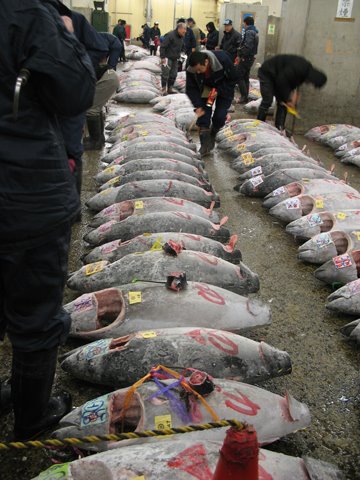
The auction was in the back of the market, where whole headless tuna, all frozen, lay on the ground and were being inspected by men with hooks that looked rather like crowbars, hacking into the flesh near the tail to examine its quality.
The auction was fast, fascinating and completely incomprehensible. Several auctioneers would hold up their hands and sort of chant rhythmically while potential buyers made gestures with their hands that I didn’t understand. It was great.
As the sun rose we stood in line for early morning sushi, shivering a bit in the cold.
I was back at my hotel a little after 7. Fujiwara-san picked me up at 8:20 and took me to the train, rode me to the airport, led me to check-in, pulling my luggage all the way. I thanked him and we bowed several times as I went off to check in.
I thought that was the last I would see of him, but after I had checked in he was waiting on the other side, making sure everything went all right. We could use more people like him.
I slept well on the flight home.
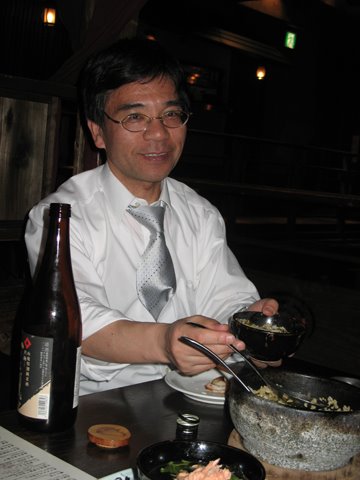
This is a picture of Fujiwara-san dishing up a rice dish at Gonpachi. Isn’t he great?

Murakami to Shibata

Okay, back to my Japan trip:

March 20

On Sunday we took a train to the town of Murakami, in the northern part of Niigata prefecture, which has both a type of cattle and a preparation of salmon named after it. We sampled both at lunch, prepared by a chef who both hand-selected the salmon that was hanging outside to dry and prepared Murakami beef in a stew, in raw squares to be grilled at our tables, and cooked sous-vide with a ponzu mousse.
Even during salmon season, the local variety isn’t eaten fresh. Although it’s highly prized, it’s only prized after it has been salted and dried for between one and ten months. I'm still trying to ascertain which species of salmon it is. It’s not king or sockeye, and the locals seemed inclined to believe that it was chum, but I’m not convinced the language barrier was breeched, so I’m doing further research. I bet it’s either pink or chum, which generally are eaten canned in the States.
We also had wasabi shoots cooked in dashi; tofu mixed with macha, white sesame, kudzu and sugar; and more great things I don’t have time to mention.
The grilled Murakami beef was served with wasabi and salt on the side.
I cannot recommend enough eating beef with wasabi.
After lunch we strolled around Murakami, which was conveniently holding a sort of doll festival, and finished up our tour at a facility where salmon was being hung to dry.
Then it was off to an onsen in Shibata. An onsen is a hot spring, but it’s also the resort built around it. Public bathing is a longstanding custom in Japan with many trappings that either are not as complicated as people like to imply or were completely lost on me.
During the bus ride up we stopped by a different onsen to look at it. Our hosts seemed to want us to know that we were to bathe before going into the hot springs and that we were to enter the springs naked, but they didn’t want to actually say those things. I’m not exactly sure why, but I sensed that pointing out such obvious things were embarrassing and awkward, which I guess I understand.
Then when we checked into our own onsen, Tsukiyoka Seifuen, I was visited by two men from our Japanese entourage and a maid from the staff to instruct me in the art of wearing a yukata, the traditional clothing to be worn to and from the baths and generally throughout the facilities. I began to fear that learning to wear such garb would be more difficult than learning to speak Chinese or even tying a bowtie.
But it turns out that a yukata is a bathrobe. It's tied with a sash rather than a belt, and it doesn't have any loops to guide the sash, but it's a bathrobe, with an optional jacket. I thought maybe the knot with which one tied the sash might be complex, but no, it's a regular bow, normally worn on the right side if you're a man, although some people wore it in the back. No big deal.
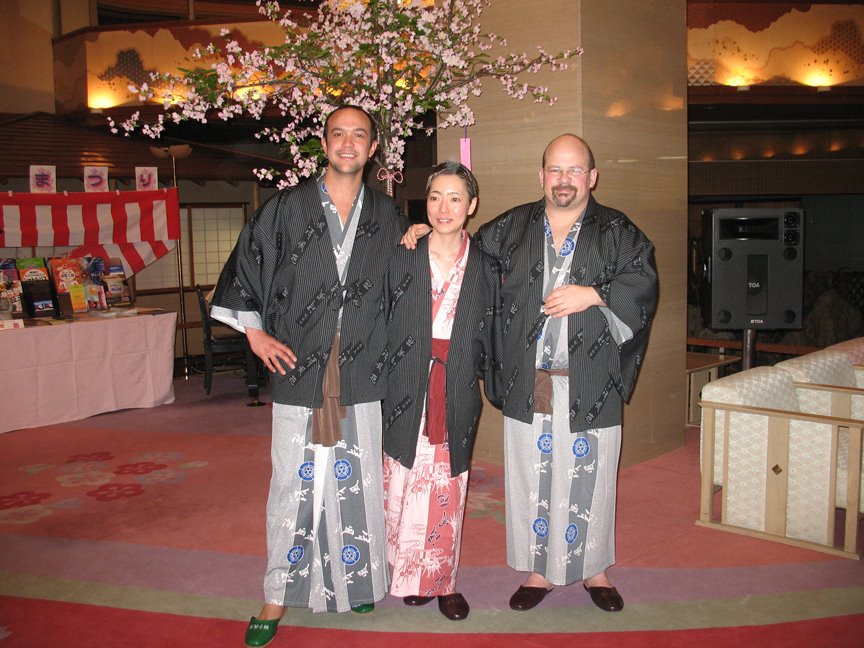
Here are Naren, Akiko and me in our yukatas. I’m on the right.
The onsen is quite obviously the father of the Western-style spa, with relaxation and non-formality a requirement. So we all wore our yukatas to dinner — seated on the floor, which I suppose has the potential for embarrassment when wearing a bathrobe, but we managed. Dinner was sashimi served in hollowed-out ice globes, cooked seafood garnished with cherry blossoms and other nods to springtime, tofu flavored with a vegetable called yomogi and topped with kaiwari greens, chawan mushi, braised Echigo pork — another Niigata delicacy — tempura, fish stew and on and on. One difference between onsens and spas is that overeating seems to be encouraged at onsens.
In our private dining room, apart from tables and tatami mats, an uncharacteristic bar with sake and a motley selection of mixers. Naren eventually took this as a cue and began to prepare sake cocktails, which went over well.
Our hosts had noticed that Naren enjoyed staying out late drinking, and that I didn’t mind either. He had said that a quiet, early night at the Onsen would be nice, but they seemed to think he was just being polite and they trundled us into a van — still dressed in our yukatas — and took us to the local izakaya, where we ate Japanese cucumbers with miso and raw squid with raw quail egg and drank sake and beer. I also had shochu with hot water and salted plum, something I'd learned to enjoy from Yasuo Kusano, the Northeast Asia bureau chief of Asia Times, where I worked in Bangkok.

Tuesday, March 20, 2007

Thirty-two business cards later...

March 18

If you ever get a chance to be the guest of honor at a dinner thrown by the heads of Niigata’s food and beverage world, I suggest you go for it. You might want to do some stretching first, though. Niigata’s old school, and that means festive dinners are eaten at low tables while guests sit on legless chairs — basically on the floor. It’s murder on the knees if you’re not used to it.
A local television crew was there as our hosts at O Noyya restaurant greeted Naren and me.
Naren was seated at a table of sake experts. At my table were authorities on Niigata's food. I was seated next to Takeshi Endo, a local businessman and an old friend of Akiko’s. Takeshi has an MBA from Boston University, a degree he called a “Masters of Being in America.” He also later referred to it as a ”BS in BS.“ He was armed with an electronic dictionary which proved less than useful when trying to identify some of the mountain greens and other vegetables we were eating. It informed us that shungiku was "spring chrysanthemum" or "garland chrysanthemum,” from which we learned nothing, but it was fun listening to Takeshi try to pronounce “chrysanthemum” (no disrespect to Takeshi, chrysanthemum's hard to pronounce). It reminded me of one of my teachers in China, who never got much closer than "krimasanathem."
Our first toast was going to be with beer until Kenji Ichishima, the tall, cosmopolitan president of Ichishima Sake Brewery whom Naren had adopted as his mentor, insisted that it be with sake. He had a point.
So we toasted with sake and Takeshi went through the process of quizzing the experts across the table about what we were eating. I’d be fine with not eating some of it again, like a slimy seaweed called mekabu and a tiny, unbelievably salty shrimp called agahiye, which means "red moustache." The agahiye was served with finely minced pickled daikon.
But the buri was unbelievable. Buri is what kampachi and hamachi become when they grow up, which is to say mature yellowtail. My hosts said the yellowtail from the cold waters of the Sea of Japan was fattier than others. They also said that, as far as they were concerned, buri worthy of the name must be wild. Most yellowtail apparently is farm-raised.
I later asked Akiko if there were a generic Japanese word for yellowtail. She said there wasn’t.
Anyway, the buri was delicious, but my hosts said that, because it was so fatty, eating it as sashimi soon caused palate-fatigue, so they also eat it as shabu shabu — the Japanese version of a hot pot. A simmering pot of broth was on the table, and they had me compare the buri raw and cooked, first insisting that I must never let my chopsticks lose their grip of the buri as I dipped it in the broth, lest someone else eat it. It was a joke, but the Japanese have a lot of protocol and I didn’t want to mess anything up.
But of course the buri immediately slipped out from my chopsticks' grasp and into the broth, but I recovered it instantly, preventing it from being overcooked.
Both preparations of buri were completely engrossing and I almost forgot that I had to interview a chef for Nation’s Restaurant News. Fortunately, I remembered in time and began quizzing Yokoyama Norio, the chef-owner of Murui Sushi Restaurant, one of 170 sushi restaurants in the city of Niigata, which has about 800,000 people.
I’m not sure exactly what happened next, but apparently I had gotten me and my entourage invited to Murui for a second meal. There Yokoyama-san’s underlings introduced us to some of the innovations that he had discussed during our interview, which I’m not going to tell you about lest I steal the thunder of my upcoming article.
But I will tell you that one of the pieces of nigiri sushi I had was topped with shrimp brain. That definitely required a good belt of sake, which I found went remarkably well with shrimp brain.
The highlight of that second meal, simply for the experience, was a dish of water and live shrimp, their legs scrambling in the water. Takeshi giggled and expressed a lack of interest in eating it.
“How do I eat it, I asked,” and Yokoyama-san tore off the shrimp’s head and had me suck out the interior as he ripped off the shell, so I could eat the body. Not bad, but the raw-shrimp sushi that followed actually was better for some reason. Kenji said that was generally the case. Maybe it’s similar to having roasted meat settle before carving it.
Then it was time to cater to Naren, which meant barhopping.
We started at a bar with walls lined in Americana where the bartender specialized in sake cocktails. Someone in our entourage produced peanuts and I asked if they were from Niigata, too.
Kenji laughed. “No, they’re from Chiba Prefecture,” he said, as if everyone knew that that’s where peanuts come from.
We then went to a bar where I sampled a sake cocktail made with cherry blossom liqueur and grapefruit juice squeezed to order. The bar snack served their was chicken breast boiled in sake, peppercorn-coated cheese, pomegranate and a frozen lychee imported from Taiwan.
The lychee was semi-thawed to a precise state in which it was easy to eat, but not so thawed that its texture would be compromised.
Naren made it to two more bars, but my last stop was a place simply called The Bar. And that’s exactly what it was. Hidden on, like, the 5th floor of an office building, a row of stools, a varnished bar, a solemn bartender with greased back hair and, behind him, an array of whiskeys, some of which even Naren had never heard of before. I sampled some Sazerac rye while Naren watched the bartender make, with great deliberation, the best Manhattan he had ever drunk.
The bartender was so intense, and we watched him with such seriousness, that eventually he broke down and giggled.

Saturday, March 17, 2007

A reprieve from the hangover gods

March 17

Naren and I greeted each other with some confusion in the hotel lobby at 7:50 a.m., ready to leave for Niigata. It wasn’t the morning-after confusion brought on by sleep deprivation, dehydration and alcohol withdrawal that one could reasonably have expected from the night before. No, we were confused by the lucidity and general sense of well-being we both were enjoying.
In fact, although we had left Akiko in the hotel so we could findt ramen at 2:30 a.m., and she had given us a stern warning about the need to look sharp in case Niigata television wanted to interview us, we had beaten her downstairs.
We spent the hour-and-half on the bullet train to Niigata photographing and asking questions about seven bento boxes that one of our growing number of traveling companions from Japan Railways had fetched for us — one from Tokyo, six from Niigata.
We arrived in Niigata and were greeted by more JR people and government types, checked into the hotel and then headed to a sake festival, at which 92 of Niigata's 97 breweries participated.
It looked like a trade show. We were led around by the event's organizer — one of the brewery owners — who explained the finer points of sake to Naren while I chatted with Philip Sugai, who teaches marketing at the International University of Japan in Niigata. He’s a white guy from Rhode Island, but he has been in Niigata prefecture for seven years, having married a Japanese woman and taken her surname. This, he said, is quite a common practice in Japan and has been for centuries. Families without reputable sons often adopt their daughters' husbands to continue the family lineage, he said.
Anyway, Philip and his wife Yoshie clued me in on many of Niigata’s delicacies while I followed the sake tasters around and sampled their wares.
I kind of paid attention to the sake facts, too. I learned that Niigata is the third-largest producer of sake and that, while the producers in Kyoto and Tokyo tend to produce sake on a large scale, Niigata's sake brewers tend to be smaller and more boutiquish. Their sake is relatively mild, owing to the indigenous rice variety, Gohyakumangoku. However they have been crossbreeding that rice with Yamadanishiki from Kyoto. The resulting rice, Koshi-Tanrei, combines the smoothness of one parent with the rich body of the other.
At the festival we also ate many fried things and witnessed the comedic stylings of a Manzai team.
Philip said Manzai is a brand of comedy from Osaka in which two guys play off of each other à la Abbot and Costello.
There also were Ginza dancers.
Oh, and Naren and I were interviewed by a local TV journalist.
After the festival I could have taken a nap, but I didn’t need one. It is truly strange.
And now, I'm off to dinner...

Why James Bond’s Martinis are shaken, not stirred

March 17

Everyone (well, okay, the few dozen people in the cocktail world and various dorks like me who care) knows that Martinis generally are to be stirred, not shaken. Shaking usually is only done with cocktails made with fruit. So what is James Bond’s problem? Surely Mr. Sophisticated should know that.
I’ve posited my own theories about that earlier, because that’s how big a dork I am, but I had the chance to ask that question yesterday of Naren Young, a cocktail expert who is on a trip to Japan with me.
We arrived in Tokyo yesterday, and during the flight I had time to sleep, eat and watch two-and-a-half movies, including the latest James Bond hit, Casino Royale. I noticed that the Martini 007 ordered wasn’t just gin and a little vermouth with an olive. Oh, no. It was something more complex than that involving Lillet and a lemon twist. I didn’t catch exactly what it was because since I got a DVR my ears have become lazy, having grown accustomed to my ability to rewind and listen to dialog again.
But since it was top of mind, I brought it up with Naren, who said that the drink in question was, in fact, part of the first James Bond novel, Casino Royale. It was three parts Gordon’s gin, one part vodka (brand unspecified because who cares?) and half a part Lillet, shaken, with a twist.
Naren — which actually is short for Narendra, in case you were wondering — explained that shaking does two things: it dilutes the drink faster, obviously, but it also aerates the drink, giving it slight effervescence. This is, in fact, desirable for the Martini variation that Bond orders, which has come to be known as a Vespa, named after an arch-nemesis of his (or rather, per Josh's comment below, Vesper, for Vesper Lynd, who is a nemesis of sorts).
Naren ordered that for us at Hoshi, a very excellent Tokyo bar in the Ginza area that had been recommended by friends of his on the bartending circuit (Naren himself tends bar at two New York places, Public and Pegu Club). It was a very cool, very upscale establishment on the seventh floor of an office building and the nicest bar I’ve been to by an order of magnitude to allow its clients to remain passed out in public view. The drunk young salaryman thus slumped on the bar added an excellent bit of ambience that is difficult to explain. So did Hoshi Yuichi, the enthusiastic bartender.
We never would have found Hoshi had we not been walked there by a staff member of Tender, another bar on Naren’s list.
Tender Bar, instead of bartender. Get it? I didn’t until Naren explained it to me.
There we sampled many house cocktails, the most interesting of which was called Shungyo, or "spring dawn." It was made with green tea liqueur, vodka and sake, and was garnished with a cherry blossom that had been preserved in salt. It was the garnish that made the drink representative of spring, even though it was preserved in salt. It’s interesting how the Japanese bring seasonality into their food that way.
Naren and I are both guests of Niigata prefecture, where he is learning about sake and I am learning about the area’s food. Our guide is Akiko Katayama, a New York based journalist and all around cool person.
Despite the inevitable grogginess, we felt that it was necessary to paint Tokyo a little bit red before leaving for Niigata the following morning. Akiko suggested we go to the Ginza, which of course we did.
After wandering the back alleys for awhile we stumbled into Yoshihiro, which apparently is a rather well known restaurant, although Akiko and our guides from Japan Railways hadn’t heard of it. Then again, Akiko lives in New York and our JR friends are from Niigata. We were mightily pleased, though.

Here’s what we ate:

Matzuzaka oxtail from Osaka simmered for four hours in soy and mirin, garnished with some kinome, an herb that I learned later in the evening is supposed to be smacked between your palms before being eaten. That releases the aromatic oils and makes Japanese people think you know what you’re doing.
Sashimi of Matzuzaka beef, katsuo, madara (a fish from Hokkaido), maguro, a shellfish called tsubu that we couldn’t identify and some sort of internal organ of the tsubu, all served with soy sauce, grated ginger, grated garlic, fresh wasabi that we grated ourselves on sharkskin, shiso and myoga — an aromatic root vegetable that looked like an onion but that tasted like nothing I’ve ever had before.
Tomato wedges with freshly grated Himalayan rock salt.

We drank Yebisu (a dark beer) and warm sake — something that is out of favor in the US but that can be pretty awesome. Naren also had shochu served with a large ball of ice that apparently is a common thing to do in Japan. Naren hopes to find the stuff needed to make those ice balls and introduce them to the Pegu Club.

Naren and I finished the evening by goading one of our Niigata friends, Kunihiro Yoshioka (he said we should call him Kuni) into finding a late-night ramen place for us. He said he knew of an all night Italian place where we might be able to get spaghetti but he speculated that all ramen places would be closed at 3am. But we sent him forward into the night and in about three minutes we found our ramen place and I had one loaded up with wakame.