Tuesday, January 30, 2007

Varietal

January 30

I’ve interviewed Varietal’s pastry chef, Jordan Kahn, twice now, but I hadn’t actually eaten in the restaurant until last night. I ate with luminary publicist Irene Holiastos.
(Okay, maybe she’s not a luminary, but neither am I, and that didn’t keep some nice bloggers from referring to me as one.)
At the end of the meal, management chatted with her about the restaurant’s first full-fledged review, which will be coming out in this week’s Time Out New York. Their fingers are crossed.
Other reviews are destined to follow; apparently three big critics were all in the restaurant on the same night recently, no-doubt trying to be anonymous. That’s so cute of them.
During dinner, Irene came up with suggestions of things for me to do when my nieces and nephew visit this April. I doubt I’ll be doing much with Alia, since she was just born in July, but I’m working on a day of fun with the other two young’uns, aged 7 and 11.
Irene said we for sure had to go to the Empire State Building and agreed with me that Dylan’s Candy Bar and/or Serendipity were in order. She also suggested a trip to FAO Schwartz, and a tram ride to Roosevelt Island.
I'm open to other suggestions (Tahirah and Harrison, if you’re reading this, that means you).

What I ate and drank:
A little spoon of pork loin with walnut, apple and dried sage
Fennel pollen-seared Nantucket Bay scallops with frozen white grapefruit tuile, microfennel, American lumpfish caviar and crème fraîche
Gaston Chiquet Brut Tradition
Dizy, Vallée de la Marne, N.V.


Prosciutto-wrapped quial stuffed with grits, baby arugula and black truffle salad
2004 Côtes de Reigny Sancerre

Pork belly braised in apple cider, tobaco, cedar and pork stock, and pan-roasted pork loin over braised collard greens and celery root purée
2004 Tenuto Roca Dolcetto d’Alba


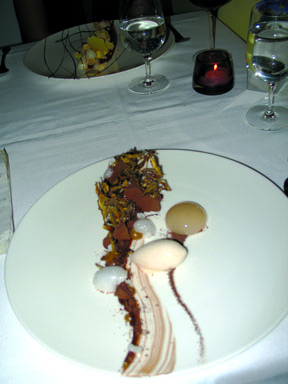
Chocolate gel with encapsulated pear purée, green pear sorbet, Poire William rock candy, mastic foam, dehydrated chocolate mousse, maitake mushroom toffee and crystalized shiitakes

The wines all were selected by server Adam Schuman, who also recommended a wine that would “change your life”:
2003 Nicolas Joly Coulé de Serrant, Savennières

He didn’t pour me any, presumably because Varietal sells it for $160. I have no gripes about that.

Monday, January 29, 2007

Bill Yosses' new job


Back in November I repeated a rumor I'd heard that pastry chef Bill Yosses was doing something at the White House and wrote that I should probably investigate that further, which I didn't do.
But my colleague Paul Frumkin just learned that he is the White House's new pastry chef.
“Chef Yosses has impressed us from the start with his original and delicious creations. He has a light touch with desserts, and the enthusiasm with which he approaches his profession makes him a real asset for all of us in the White House," First Lady Laura Bush was quoted by a press release from her office as saying.
Bill Yosses was the pastry chef at Bouley Bakery before cooking at Citarella, the restaurant, first as executive pastry chef and then as executive chef after Brian Bistrong left and became chef at The Harrison. Most recently he was working on the menu at the Westport Playhouse. He also owns Boi, a Vietnamese restaurant in Manhattan on E. 44th.
He’s big on incorporating Asian flavors into his desserts.
Desserts he’s made in the past include a Pear Dauphinois, made by layering paperthin layers of pear (soaked in pear juice and pear brandy) with Fourme d’Ambert cheese and baking it until it collapses and melds together. At boi he served coconut tapioca garnished with diced mango, toasted coconut, basil seeds and pomegranate molasses.
At Bouley bakery he used to make walnut-saffron bread

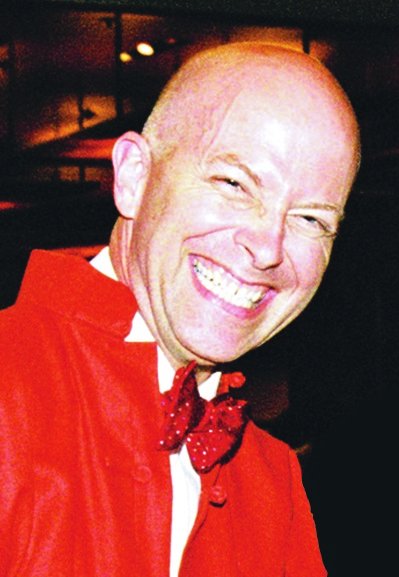
He looks so happy in this picture, and yet so blue. I'm going to have to work on that coloring.

Friday, January 26, 2007

Patroon’s new chef


January 26

Patroon in New York City has a new chef, Bill Peet. He has been cooking in restaurants for 35 years, since 1972, and spent 15 of those under the legendary André Soltner at Lutèce. More recently he was a chef and partner at Pair of 8s.
And that's usually all I have space to say about a new chef, except here on my blog, where space obviously is not so precious.
So let's talk about Bill a little bit more.
He actually arrived at Patroon in November and has been working on the menu since then. "It's about 75 percent right now," he said.
New appetizers include a $16 dish of three prawns, with their heads on, cold-smoked over applewood, grilled and served with mâche salad and roasted tomato vinaigrette.
He also has a $14 dish of Manila clams and Prince Edward Island mussels braised with shallots, white wine and linguiça, served with grilled country bread.
His version of a crab cake is a 50/50 mix of jumbo lump crab and diced sea scallops, bound with aïoli and just a bit of bread crumbs. He also coats it with bread crumbs, sautés it and serves it with a green apple and celery rémoulade with hazelnut oil.
That's 16
A new main course is dark beer-braised beef short ribs. He removes the ribs from their bones and then rolls the meat into the form of a filet. He serves that with carrots that he roasts on a bed of rock salt, which intensifies the flavor by draining out some of the liquid, as well as whipped potatoes. At service he sautés the carrots with butter, salt and pepper and tops the dish with baby celery leaves. That's $29.
He also serves a pan-seared New Zealand venison loin which he has marinated, generally overnight, with thyme, cracked black pepper and olive oil. It's served with braised red cabbage and a sweet potato puree that he's been making for years: He roasts the potatoes and scoops out the flesh, and then adds a roasted banana to that and puts that mixture through a food mill. He flavors that with an infused maple syrup that he makes by roasting bananas, an orange and a vanilla bean and storing them in the syrup. That's $32.
Bill says he likes working at Patroon, because "it’s built to be a restaurant.” It has a back stairway, a banquet room, a roof that’s open in the nice weather, “and it’s just laid out correctly. It’s great.”

Tuesday, January 23, 2007

Ad Hoc

January 23

Last Saturday, my one free night during the Worlds of Healthy Flavor conference, I had dinner at Thomas Keller’s new place, Ad Hoc. He named it that because he got the space and temporarily turned it into a restaurant before he really knew what he was going to do with it. But what he turned it into is doing so well that he has decided to leave it as it is: a single prix-fixe menu with a modest wine list.
I ate alone and didn’t bring any reading materials (it would have been too dark to read anyway). Often in situations like that it’s a lot of fun to eavesdrop on the conversations at other tables, but they were not interesting, so instead I kept the menu and analyzed the list of wines by the glass.
I used my juice to get my reservation, so they knew who I was and that I was coming, and I left it up to them to pair wines with my main course and cheese (I would have had them pair wine with each course, but I was driving).
So, after a salad of frisée and roasted beets with shaved fennel, radishes, herbs and raspberry vinaigrette, I was to have Liberty Farms Duck Breast over dried Turkish apricots, figs, cranberries, sultanas and mixed nuts, with a side of farro and arugula.
That was to be followed by Emmi’s Swiss-aged Gruyère with Marshall Farm’s orange blossom honey and Granny Smith apples.
I decided that how they chose the wine to go with my duck would say less about their ability to pair wines with food than it would about their opinion of me. Really good service, after all, is assessing the desires of the guests and fulfilling them before they even know they want them (I learned that at Azar’s Big Boy in Denver).
And the wine one chooses can speak volumes.
The choices:
Fogdog Pinot Noir from Sonoma — To be ordered by someone who was captivated by Sideways; one of the most expensive choices, but probably a bad one for duck, so let’s move on.
The Shiraz from Western Australia would be big, loud and ordered by someone trying to be trendy but three years behind.
The Argentine Malbec would be selected for someone who wants to go off the beaten path, but doesn’t really know how to.
The Spanish Rioja — trendy but tasteful
The Napa Cabernet Franc — the choice of the effete intellectual (and what I would have ordered)
The Oberon Cabernet Sauvignon — bigger, louder and stupider than the Shiraz.

For me, they chose the Oberon Cab (Ooh snap!).

Of course, that shows what I know, because it went perfectly with the duck. All of the others would have been too light, even the Shiraz which, my server explained, being from Western Australia would have been a bit too soft for my fruity duck.

So he picked the biggest red for my duck. Where then, do you go for the cheese?
Would you believe a 2005 Alpha Domus Sauvignon Blanc from New Zealand (no, not Marlborough; Hawke’s Bay)? The choice was between that or a Tawny Port, my server said. The cheese brought out the wine’s sweetness, and the wine in turn cleaned off the palate between bites.

Dessert was a warm chocolate brownie with caramel sauce and whipped cream, and my server talked me into letting him give me a bit of late harvest Zinfandel from Sonoma with it. I nonetheless made it from Yountville back to St. Helena safe and sound.

Quotes of the weekend, and a recipe

January 23
I spent today opening mail, responding to e-mails and so on because I spent Thursday, Friday, Saturday and Sunday at the Worlds of Healthy Flavors conference and its coda, a meeting called Produce First! [sic]
Yesterday I spent driving from St. Helena to Oakland and then flying to New York.
I mentioned those confereneces two blog entries ago, and I'll probably put most of the salient points into my next column in Nation's Restaurant News, but for you, dear blog reader, are the best lines from the meeting.

Karen MacNeil, on the aroma in Pinot Noir wines described as animale: “The slightly sweaty, sexy smell of men who have run one mile, but not five.”

Rick Bayless on Tex-Mex: “That comforting food with melted cheese.”

Suvir Saran, explaining that “curry” means a whole range of stews, not the curry powder, which was invented by the British: “If you hate curry, blame the British, if you love curry, thank us and call it something else.”

Suvir Saran, on how little Americans know about India, but really talking generally: “The ignorance of people actually educates.”

Suvir Saran, again: “Asafoetida is nature’s Beano.”

And now, a recipe for terrific batter for making frito misto, or really batter-frying anything (you might not think that this is the best recipe to take away from a conference on healthful food, but one point at the conference was that everything is fine in moderation, except for trans fats):

3 cups cake flour
3/4 cup cornstarch
1 tablespoon baking soda
1 tablespoon salt
Club soda

Mix the dry ingredients and then stir in the club soda until the mixture is the texture of heavy cream.

And that’s it!

publicist wanted

January 23

Got a call yesterday from the owner of Lewis & Neale, a nice PR company that represents things like highbush blueberries, Prosciutto di Parma and the National Dairy Board. They’re looking for someone who knows about food and has experience at a PR agency. If that sounds like you, and you know how to contact people like me without irritating us, give them a call. Perhaps you’ll be able to lead me on a trip to look at the Mexican avocado harvest someday.

Sunday, January 21, 2007

produce

January 21

You might remember Adam Sherrett, the Shecky's nightlife editor, from my last blog entry.
Well I ran into him the following night, too. That was the last night I was in New York before coming to Napa Valley for the Worlds of Healthy Flavors conference at the CIA.
In my kind, gentle world, the CIA stands for The Culinary Institute of America (and the NRA is the National Restaurant Association). The CIA has two campuses, one in the Hudson Valley, and one here. Worlds of Healthy Flavors is an extension of its Worlds of Flavors franchise, which is why it's not a very good name (how can you say that a flavor is or isn't healthy?).
The conference is an attempt to instruct the foodservice world about how to make its food better for customers, and to do it in a way that will induce customers to eat it.
You see, it is a well-established fact that most restaurant-goers will shy away from anything that's supposed to be good for them. Really. I'm not being flip. As much as Americans say in surveys that they would like to eat more healthfully, put a little heart-healthy symbol next to a menu item, or suggest in the wording of the item that it might be good for you, and the sales actually will drop, almost invariably.
So The CIA has started to use the term "stealth health." Through stealth health, you just make the food better for people without telling them. So you might switch from a white bun to a whole-wheat bun, but instead of marketing it as a whole-wheat bun, you call it a honey-ale whole-wheat bun (assuming you have flavored it with honey and ale, of course).
But why bring in "worlds" when it comes to stealth health? Because anything that's good for you on a menu has to go toe-to-toe with the burger and fries that invariably also are going to be on the menu. It has to be more appealing than that familiar burger. Are you going to do that with a boneless skinless chicken breast and cottage cheese? Of course not.
Ah, but what about a spicy Thai salad, or a vibrant ceviche? What about starting with something, anything, that doesn't have the stigma in mainstream Americans' eyes of being good for you?
A bunch of chefs came to talk about the food from countries in which they were expert. Nancy Harmon Jenkins came to talk about southern Italy. Diane Kochilas flew in to talk about the food of Greece. Suvir Saran was there to extol the glory of the Indian Subcontinent. Mai Pham spoke about Vietnamese and Thai food, and Rick Bayless spoke and did a demonstration and spoke again about Mexican food.
They all talked, in one way or another, about how the produce in those regions was adored by the people and eaten in great quantities and with great joy.
But what, you ask, does that have to do with your last night in New York and running into Adam Sherrett?
Adam and I both were at the opening of Nurse Bettie, a new Bettie-Page-themed bar on the Lower East Side. It was hot and steamy inside, almost to the point of torture. That was perhaps appropriate for a bar named for a pin-up girl who often posed as a dominatrix, but I would have turned around and left had I not run into a couple of people I liked and decided, on Adam's recommendation, to try the signature cocktail made with gin and pomegranate juice.
The bartenders were a little overwhelmed and I was not inclined to work too hard to get their attention, but I was aided by two women camped at the bar. One was an Australian who worked for her country's labor unions or some such thing, and the other, the Australian's husband's cousin, was a writer, mostly about fashion.
The writer wrangled a drink from the bartenders while I quizzed the Australian about her impression of the United States.
She observed, as I often do, that our produce isn't very good.
I agreed and explained that for decades we bred produce to ship well rather than to taste good and that, despite the best efforts of a growing number of small niche farmers, our fruits and vegetables continued, for the most part, to look pretty and taste like nothing.
We agreed that this was unfortunate.
That conversation was fresh in my mind when I heard Rick Bayless talk about the produce of Mexico and how we should emulate the dishes made from them.
Well, sure we should, except we don't have their produce.
I groused quietly about this for most of the conference, which happened to be a very good conference with lots of interesting science about trans-fats and carbohydrates (including a defense, or at least non-vilification, of high-fructose corn syrup) and other nutritional things, interspersed with cool cooking demonstrations and tastings.
Most of the foodservice chefs attending were from schools -- colleges where the students actually are in to eating more healthfully, and elementary schools where the food can be more easily foisted on the kids (although it's far, far more complex than that).
There were some notable exceptions, such as chefs from Red Lobster and Denny's and Au Bon Pain, and the biggest exception of all, Dan Coudreaut from McDonald's.
Dan's an extremely nice guy, but he nonetheless was not forthcoming when I quizzed him about McDonald's next produce offering. Darn it!
The conference ended yesterday, and today it was followed by another one-day program about produce. I was delighted by our last discussion of the day, which was a panel of foodservice operators talking about their experiences in selling more produce-oriented food. I was delighted because a minor rebellion occurred during the question-and-answer period. The chefs said using more produce would be great, if only it tasted like something, if it weren't picked so early that it would never ripen, if their staff had the training to handle what ripe produce they did get, and so on and so on.
The produce at the conference itself was terrific, of course, but we are in Napa Valley, at the CIA.

Wednesday, January 17, 2007

Basso 56

January 17

I go to press dinners thrown by publicist Susan Rike because, well, it's free dinner, and because sometimes I meet interesting people at them. Her approach to introducing media to her restaurants is to host dinners of, say, between three and ten journalists at one table. She'll generally hold three such dinners over the course of two or three weeks.
I knew most of the people at last night's dinner at Basso 56 — a new contemporary Italian place near Patsy's, the old-school Italian-American landmark that was Frank Sinatra's favorite restaurant and a good place to go for a veal chop. But I hadn't met Adam Sherrett. He's a nightlife editor of Shecky's, a Michigan native who arrived in New York last August by way of San Diego.
Susan began to tell the story of Basso 56's owners, husband-and-wife team Paolo and Ellen Catini. They recently closed Basso Est on the Lower East Side and opened the new, larger restaurant which Susan said was in a less out-of-the-way location.
"Wait, wasn't Basso Est on Houston and Orchard?" Adam asked.
Houston and Orchard is right on the border between the Lower East Side and the East Village, so if you're a young New York hipster it's about as good a place as any to mark as the center of the universe. But apparently the Catinis were looking for a different crowd. And Midtown West, between the theater district and Lincoln Center certainly is a fine place to attract diners. Management said they were drawing more neighborhood foodies than pre-theater folks, just as they intended.
Paolo Catini hails from the Italian region of Abruzzo.
What we ate:

Bruschetti with burrata and speck
non-vintage Prosecco Crede, Bisol, (Veneto)

Gamberi e Canellini (shrimp and Tuscan white beans) with rosemary and olive oil
Fagottino alla polpa di aragosta (crêpes filled with confit of lobster, with tomato and chive velouté)
2005 Kerner, Abbazzia di Novacella, (Alto Adige)

Saffron risotto with asparagus and quail
Primitivo, Ca’ntele, 2004 (Puglia)

Filetto di dentice in Brodetto (striped bass) in white wine and lemon broth with fennel and Manila clams
Grillo, Firriato, 2005 (Sicily)

Petto d'Anatra in Crescione (roasted duck breast) with balsamic reduction, sautéed watercress and dried figs
Nebbiolo delle Langhe, Produttori del Barbaresco, 2004 (Piedmont)

Assorted desserts, including a crepe in chocolate syrup and a sort of hazelnut napoleon.
Brachetto d’Acqui, Marenco (Piedmont)

Tuesday, January 16, 2007

Dining with Chandler

January 16

Chandler Burr likes Thai food, speaks Japanese and, unlike many of my other friends, quite often is free for dinner at the last minute. So I’ve been seeing a fair amount of him lately.
You might know Chandler from his previous appearances in this blog* *, or, more likely as a rather famous writer and journalist in his own right.
Chandler's fun because he has the usually charming tendency of speaking his mind. When I grew a goatee recently I knew that if he didn’t like it he would declare it a travesty and strongly encourage me to remove it (it turns out he approved of it). He’s also really smart and makes entertaining statements about things.
As the New York Times’ scent critic, he pays attention to the way things smell. So as I downed hunks of onion at Pam Real Thai a couple of weeks ago he expressed wonder that Thais ever manage to reproduce given their breath (he rejects as preposterous the notion that if everyone has similar breath, they don’t notice that it’s bad).
The topic of politics came up earlier this week when we were eating with my friend Yishane Lee at Tigerland — a place in the East Village that serves Thai and Vietnamese food using many organic things and Berkshire pork, and featuring house-made Asian sodas and an all-New York wine list. Chandler said the Democrats were now the conservatives and the Republicans were Marxists (he was referring to the social engineering being attempted in Iraq).
Last night, for no reason in particular, I was in a lousy mood as I shared a taxi with Iron Chef judge Akiko Katayama. We were going from from an olive oil launch party at Ureña to Sushi of Gari, where I was meeting Chandler for dinner.
Sushi of Gari's publicists like to invite a bunch of journalists to dinner over the course of a couple of nights. The result is fairly festive, since New York food writers tend to know one another and to get along reasonably well. So on the way to hooking up with Chandler, who had seated himself in the back next to freelance writer Jean Tang and a friend of hers visiting from Hawaii, I said hello to Andrea Strong and her nice boyfriend whose name escapes me at the moment, and James Cury, Time Out New York’s Eat Out editor, who was dining at the bar with his mother.
I recommend getting to know James. He’s a really nice guy, and good at his job, too.
I had been repressing my foul mood until I sat down with Chandler, and then complained freely between Chandler's converations in Japanese with the chef. Chandler said my bad mood was kind of a refreshing change from my usual pollyannalike demeanor. That might have been true.

Wednesday, January 10, 2007

good turn-out

January 9

Chef Zak Pelaccio, of 5 Ninth and Fatty Crab, was playing with some handheld device as I saw him outside New York’s International Culinary Center. That’s the new name for the building that houses the French Culinary Institute. The people in charge there just expanded their territory from 30,000 to 70,000 square feet and added the Italian Culinary Academy. Today they were celebrating the new space with a demonstration by apparently famous chef Massimiliano Alajmo of Michelin-three-star restaurant Le Calandre in Padua.
Zak wasn't the only important chef at the event. I walked into the auditorium and immediately saw Christopher Lee of Gilt, and then Brad Farmerie of Public and Dante Bocuzzi of Aureole.
Marc Vetri from Vetri came up from Philadelphia. He said he had eaten at Le Calandre and wanted to meet the chef.
Fabio Trabocchi from Maestro came up from DC (McLean, Va., actually). Cesare Casella from Maremma was there, but he's dean of the new Italian school, so that's no shock. And Alain Sailhac and André Soltner are affiliated with the school, so their presence was expected. Nils Noren's, too. But it was still nice to see them.
Wylie Dufresne slipped in around the time when the presentation started, or at least that’s when I noticed him.
Writers were there, too, like Rozanne Gold, Malachy Duffy, Mitchell Davis and the inimitable Christine Muhlke.
Regina Schrambling was there, too.
“Late night?” she asked me. I don't know what might have been wrong with how I looked — I had even done extra grooming of my new goatee that morning — and I didn't bother to ask. Instead I just sat between her and food historian Meryle Evans and quietly cracked jokes with Regina as Alajmo gave his spiel.
Tom Colicchio walked in at some point, and when we went upstairs for a food sampling, restaurateur Tony May was talking to the chef. Jacques Pépin wandered in later on.

All for the opening of a cooking school. Impressive.

Thursday, January 04, 2007

Death n Co.

January 4

On a quiet night of a decidedly bad week at Nation's Restaurant News, I decided to follow the lead of eater.com and check out Death & Co., a new bar in the East Village.
The name refers to Prohibition-era posters that were disguised as temperance propaganda. According to my bartender, Marshall, they depicted the road to Hell, paved with different types of alcohol, but were in fact maps to speakeasies. It's amazing, the creativity that springs from repression.
The bar's sipping-spirits list is interesting, with more American ryes than Scottish single malts and more tequilas than ryes. I sampled three cocktails, made respectively with rye, tequila and a rum from Martinique (I'd go into more detail, but I'm writing this after having drunk three stiff cocktails).
Marshall shook the drinks that contained fruit and stirred the ones that didn't, following tradition and logic while flouting James Bond. I posited my theory that perhaps 007 wanted his Martinis shaken and not stirred because, as a spy, he wanted to remain relatively sober, and shaken drinks would result in more melted ice and thus contain more water. It's a plausible theory, but it does ascribe a whimpy quality to Mr. Bond that belies his character.
I sampled some food, too. I was leaning toward mac & cheese, but the waitress convinced me to try the evening's special, bouillabaisse.
I was alone and the bouillabaisse was clearly meant to be shared. It arrived on a marble tray in six ceramic mini-goblets, each in front of its own baguette crouton topped with crab, Dijon mustard and rouille. I said it looked Gothic, and one of the bartenders commented that many customers were describing various elements in the bar as Gothic. He suggested that perhaps they should have a guy in the bar dressed all in black with long, black bangs and on the sound system, instead of the jazz that we were listening to, they should play The Cure and Siouxsie and The Banshees.
I said Gothic was different from Goth.

Wednesday, January 03, 2007

Look Ma, no keyboard!

NRN's fledgling podcast site has been updated and I have a couple of new columns there that you might enjoy.

Friday, December 29, 2006

Dennis Foy

December 28

You might think that a fine dining restaurant with the name of this blog entry might be pronounced in French — dunee fwah. But no, it’s named after its owner, who used to own Mondrian and other restaurants, and pronounces his name as you'd expect an American to pronounce it.
I went there with my old college friend Jonathan Ray, who is now a history professor at Georgetown (tenure track, thank you very much). His degree, from Columbia, is specifically on Jews of Medieval Spain — 13th Century I believe — during the Reconquista, when the Christians were in the process of capturing Spain from the Muslims.
Jonathan likes to bust my chops when I say things like "Spanish food is hot." He'll point out that really it's only hot among a few American cognoscenti who bother to declare such things to be hot, and that most Americans eat burgers and fries and steak and so on and are not particularly interested in sampling pulpo a la plancha. And of course he's right.
I visited Jonathan in Spain when he was working on his dissertation. He had to visit various archives, which are only open a couple of hours each day, so I came for part of his trip to entertain him during the rest of the day.
Jonathan speaks Italian, Spanish and Portuguese and can get by in French and German, so he's good to travel with in Europe. He's also pretty good at pointing out the significance of various ancient walls and so on, but he's most fun for conversation — at outrage, outrage over bad architecture, for example.
In Barcelona we had an argument that I welcome you to join in (we're over it, but I'm curious to hear other people's opinions).
Catalonia, of which Barcelona is the capital, is home to Ferran Adrià and a variety of other chefs who have been instrumental in developing a cooking style that at the moment is being called Molecular Gastronomy (the term's on its way out; I give it another two years). Essentially, members of this artistic school of cooking use ingredients more commonly used in food manufacturing — various gums, modified food starches and so on — in their own (usually fine dining) restaurants.
I argued with Jonathan, that since this type of cooking was developed by Catalonians in Catalonia, that it therefore was Catalonian cuisine. Jonathan said that was preposterous, that the region's long-standing culinary tradition was far removed from the avant-garde experiments of a few artists in the hills.
I guess I should have asked him if he considered Gaudí's architecture to be Catalonian, but it didn't occur to me at the time.
I no longer know where I, personally, stand on the issue.
Anyway, the techniques developed or modified by these rural Catalonians and others (Heston Blumenthal in Bray, England, Homaro Cantu in Chicago, Wylie Dufresne here in New York, and really quite a few others at this point) has become mainstream enough that Dennis Foy felt that, in order to be part of New York's culinary dialog, and to appeal to the trend-conscious customers he'd like to attract to his restaurant, he needed to dabble a bit in the molecular gastronomy himself.
So sprinkled on his foie gras terrine is a foie gras powder made by mixing foe gras fat with what the chef called tapioca maltodextrin starch. Tapioca is an extremely absorbent starch, and maltodextrin is very much loved by pastry chefs because of its ability to stand up to humidity. So the foie gras, when mixed with this particular starch, is dried into a powder.
"It tastes like nothing," Jonathan said. I told him that if he closed his eyes and thought about schmaltz, it would taste like schmaltz.
Dennis Foy's daughter was sitting at a table near ours. He told us that she helped create some of the design elements. For example, she sourced the light fixtures, which are meant to resemble giant sand dollars. Whimsical curved beams in bold reds and greens and blues arc mostly over people's heads in a way that seemed to me remarkably unobtrusive. Dennis said such design elements were intended to keep the restaurant from being too stuffy.
Here's what we ate:

An amuse-bouche of Boeuf Bouguignon

Big-eye tuna tartare with apple and cinnamon
Roasted beet salad with Belgian endive and blood orange
2004 Robledo Sauvignon Blanc, Lake County, Calif.

Torchon of foie gras with eiswein gelée and foie gras powder
2002 Château Belingard Monbazillac (Bordeaux)

Sautéed potato gnocchi with mushroom and herb essence
2005 Fabian Montmayou Chardonnay, Mendoza (Argentina)

Wild striped sea bass with tomato confit and black olive "paper”*
Grilled sea scallops with celery root purée
2005 Fritz Chardonnay, Russian River

Braised short ribs with spicy red cabbage and baby carrots

Roasted loin of lamb with black pepper gastrique
2003 Morvada Cabernet Sauvignon, Mendoza

Pear tarte
Pumpkin napoleon with Indian-spiced apples and mango sorbet
more of the 2002 Château Belingard Monbazillac

*Black olive paper is another one of those molecular gastronomy things. It's made by combining agar agar with pureed black olives, spreading that very thinly on a Silpat and then dehydrating it.

Wednesday, December 27, 2006

Hurapan Kitchen

December 22

Taweewat Hurapan and I go way back. He was one of the first chefs I profiled for Nation's Restaurant News, in 1999, when he was the executive chef of Rain on the Upper East Side.
He has a new restaurant, Hurapan Kitchen, which he runs with his son, Dejthana, who was chef at Rain on the Upper West Side.
If you happen to be on the fencing team at City College of New York, you've probably heard of the Hurapan Trophy, which is given to the school's best fencer each year. Taweewat, who was on Thailand's Olympic fencing team in both Munich and Montreal, also did a stint as CCNY's head fencing coach.
(He lost in the first round in Munich, but he made it to 19th place out of 160 in Montreal).
Back when I interviewed him in 1999, Taweewat noted that both fencing and cooking require timing and depth perception. He also said fencing "helps in reading people's minds, because in fencing you have to read your opponent's mind and also the judge's mind. So I can also judge the customers very easily."
My friend Yishane Lee, who works for Time Inc. Interactive, and I both are friends with one of Hurapan Kitchen's publicists, Ben Schmerler, from back when he was an editor for Zagat. Growing weary of bad pitches, Ben decided he could do it better and teamed up with Michael Gitter to form their own PR company.
He asked Yishane and me separately to check out Hurapan Kitchen, and we decided to go together with Yishane's boyfriend, Ray Garcia, who also works for Time Inc., as a computer guy.
I've known Yishane even longer than I've known Taweewat. We worked together in Bangkok in 1995-96. She edited my restaurant reviews.
I picked Yishane up in her Time Inc. office and we stopped by to chat with her colleague Hooshere, who, apart from being one of Time Inc.'s web people, is a singer of contemporary Armenian music.
Hooshere is involved in the relaunching of Entertainment Weekly's web site, so that magazine had just given her a collection of their favorite bits of entertainment for the year (books, DVDs and such).
I can't tell you what was in it, but I can say that I learned that Anika Noni Rose lives in the same building in Inwood as Yishane.
Ray had some things to take care of, so Yishane and I went downstairs to Cité for wine and dollar oysters (we started drinking Sancerre but switched to a California Sauvignon Blanc).
Yishane's a walker (actually, she's a marathon runner, but she walks, too), but it was raining, so we took a subway to Hurapan Kitchen, where Taweewat sprang out and introduced me to Dejthana, whom he said was the actual chef at this restaurant.
He also pulled out some sort of hand-held computer device and showed me a picture of the profile I'd written about him. He said he uses it as his bio.
The food at Hurapan Kitchen was different from what I remember getting at Rain, which seemed toned down to suit Upper East Side tastes. The new place definitely seemed more Thai, but the chefs also knew who they were cooking for and that two out of three of us had lived in Thailand.
Ray arrived just as the appetizers did, but don't worry, he's not one of those neglectful boyfriends. In fact, he's not even a boyfriend anymore: Within 24 hours of dinner, Ray gave Yishane a ring and became her fiancé.

Here's what we ate:

Maine lobster roll with spicy greens and tangerine glaze
Roti tuna roll with pickled ginger and caramelized pineapple
Tamarind Glazed Baby Back Ribs withwild mushrooms, basil and Szechuan pepper
Tom yam kung (spicy-sour shrimp soup with mushrooms, kaffir lime and chile-lemon grass broth)
Crispy duck salad with papaya, tomato, spicy pomelo
Crispy “fillet” of whole fish with sweet-tangy-spicy sauce (a word of explanation: the fish is flavored like a whole Thai crispy fish — along the lines of pla thod rad prik, say — but instead of frying it whole, the chef fried the fillets and then served them with the fried carcass curved around them, making it exotic looking and yet convenient to eat)
Braised short ribs with roasted potatoes, peanuts and massaman curry
Fried coconut ice cream with raspberry and mango sauce
Apple & banana spring roll with green tea ice cream

Hurapan Kitchen is one of a small but growing number of restaurants that offers both light and dark roasts of coffee. The light roast is a Brazil Sanos. The dark one is a Hawaiian Kona. I have no idea if the fact that Ben also represents the coffee house Joe has anything to do with that.

Thursday, December 21, 2006

Lunch at Café Gray

December 21

I wanted to interview Gray Kunz for an article I'm working on for our special NRN 50 issue.
I hadn't really met him before. Oh sure, I've been introduced to him at parties and book launchings and so on, but unless you manage to imprint yourself on someone's memory, such encounters don't count.
His publicist, Stephanie Faison née Crane, suggested we have lunch at his restaurant in the Time Warner Center, Café Gray, and then I'd chat with him afterwards. Fine with me.
I'm not sure what you call the opposite of a media whore, but Gray Kunz is pretty much that. I don't think he's intentionally press-hard-to-get. He just seems to prefer cooking and supervising the kitchen over talking to me about Thai basil or pickled green papaya or whatever.
Many people have complained about the fact that the best views in his restaurant of Columbus Circle and Central Park are from the (open) kitchen. Perhaps it was not the wisest business decision, but I think the chef wanted a nice view for himself and his staff. He's an intelligent man; if all he wanted to do was conduct business he could have gotten an MBA and been done with it. Chefs are otherwise motivated.
During the interview we sampled some items being planned for Christmas dinner, like oysters topped with red and green tobiko (cute, right?) and shrimp cocktail with traditional cocktail spice spiked with ginger.
That was nice, although I was full from lunch.
Here's what we had:

Small bites of faro salad with pine nuts, red currants and Parmesan; peaky toe crab in mango emulsion with a plantain chip, and duck confit with beets, walnuts and crème fraîche

Truffle course:
Shaved white truffles with parsnip purée, quail egg yolk and white truffle bouillon
Chestnut agnolotti in black truffle broth with shaved black truffles
Chapuy Blanc de Blancs grand cru brut reserve Champagne

Rice flake crusted lobster in green curry broth with parsnip and salsify
Pearl noodles with young ginger, lemon grass and other spices Gray Kunz likes, topped with some lobster meat.
2002 Domaine Baumann Mandelkreuz Gewürztraminer, Alsace

Spice crusted venison with Brussels sprouts and Asian pear, riebele pasta with sour cherry sauce and kohlrabi
2002 Domaine de Bonserine La Sarrasine Côte Rôtie

Roasted pork loin with crispy pork belly and sauerkraut with apples and bacon
2004 Viña Pedros Ribera del Duero

Stewed cassis berries with Champagne sorbet in cassis soup with a splash of rosé Champagne

Kaffir lime pie with schlag and orange zest in kaffir lime sauce on chocolate cookie crust
Passion fruit chocolate cake with pomelo and chocolate sorbet, finished with pistachio
2004 Domaine de Fenouilet Muscat de Beaumes de Venise
2004 Tomaso Bussola Recioto della valpolicella classico

And because the topic of seasonal sangrias came up (doesn't it always?), we sampled sommelier Matthew Conway's winter creation made from Casorzo, a red slightly sparkling wine from Piedmont, Pyrat rum and rosemary muddled with orange peel. That's served in a glass that has been rinsed with amaretto. Added to it are kumquats and, as garnish, a cinnamon stick and a rosemary sprig.

Wednesday, December 20, 2006

Wednesday carnage

December 20

I spent the early afternoon at Varietal, a new restaurant on 25th Street, with young pastry chef Jordan Kahn, who was showing me some stuff for an article I'm working on.
He was explaining different gelling agents and acids that he's using — and that his favorite kitchen tool is acetate sheeting — pointing out, when I used the term "molecular gastronomy," that in fact all of those things are merely tools to make dessert taste good and not nearly as kooky as people imagine.
And it's true, a lot of the hydrocolloids (or gums as regular people like to call them) that the kids are cooking with these days are actually just as "natural" or more so than gelatin, and many of the hydrolyzed soy proteins and other emulsification agents they're working with have been used in food manufacturing for years. All that's new is what's being done with it.
So we were having a nice time as he plated up a pain d'épices with 10-year-old Banyuls vinegar powder, taro puree and lychee ice spirals. Then he mentioned today's article in the New York Post that condemned his "wacky" food. Jordan was saddened that the writer, long-time critic Steve Cuozzo, didn't, in his opinion, know much about food.
Indeed, in the article, Cuozzo did call mizuna and maitake obscure ingredients, which of course they are not. Jordan pointed out that McDonald's uses mizuna in its salads.
(Cuozzo called mastic obscure, too, but mastic really is obscure)
I suggested that Cuozzo perhaps was targeting his readers, believing that they would find mizuna and maitake to be obscure.
Still, Jordan admitted to a feeling of sheepishness as he came into work on the subway this morning, looking at how many people were reading the Post.
And he pointed out that most of the article was in fact not about the restaurant but about a controversial bean that tastes a bit like vanilla. The tonga bean (actually, tonka bean, see comment #5 below) is not quite approved for consumption because it contains a blood thinner called coumarin, but chefs have in fact been using it in small quantities for years (I first had it in, oh, probably 1993 at the Mansion Kempinski Bangkok, where Rafael Neitszch was chef at the time).
Cuozzo's comments on Jordan's lime curd and macaroons didn't make it into the Post article, but he told Jordan that it was "awful."
"It's lime curd and macaroons," Jordan said to me. "How can it be awful?"
He had me and photographer Michael Harlan Turkell, who also had dropped by, sample the lime curd.
Indeed, it tasted just like lime curd. If you don't like lime curd, then it would be awful, but it seemed to Jordan that as a critic it is not fitting to condemn something as bad just because you don't like it.
Now, if you've never been a critic, that might sound strange to you, but in fact he has a point. In my opinion, critics are consumer advocates whose job is to describe what something is and whether it is a good one of those.
The one type of food I really can't stand is raw tomatoes, but back when I was a critic, I still had to sample dishes that had raw tomatoes in them. I had to taste the raw tomatoes. If I didn't mind them, I knew they were bland, flavorless tomatoes. If they tasted toxic to me, I knew they were full of flavor.
Anyway, Jordan Kahn was kind of bummed out.

And now I will try, for the first time, to post a picture here on my blog. I'm not anticipating any problems with that, since I have at least half a brain and it's nearly 2007.


This is Jordan's whipped absinthe with black sesame puree, sesame nougatine, liquid sablée spirals, tarragon puffs, ricotta, green apple sorbet, fennel and tarragon.
Jordan says he's inspired by abstract expressionists and sometimes thinks of the color he'd like a dish to be before creating it.
Stop reading now if you don't want to know what all this stuff is.
The whipped stuff near the top of the plate is the absinthe which has been added to hydrolyzed soy protein, water, sugar and salt and then whipped. The largish greenish chunks are the tarragon puffs, made by adding a gum called methylcellulose (specifically Methocel F50) to tarragon water (made by blanching and pureeing tarragon, straining it and saving the water). He seasons it with salt and sugar, pipes it into divinity shapes and then dehydrates it.
Methylcellulose, unlike most other gums, gels not when chilled but when heated, you see.
The streaks that look like they might be chocolate are in fact made by cooking black sesame seeds with water in a pressure cooker for a couple of hours and then puréeing them and flavoring them with sugar and salt.
The spiral is a sablée cookie that has been pulverized, mixed with an unsaturated fat (which is to say oil), spread between parchment paper, refrigerated to let it temper a bit, cut into strips and then looped around strips of acetate.
The ricotta's curd is broken up with a paddle and seasoned with lactic acid, salt and sugar. That's the white glob at the end of the cookie.

Tuesday, December 19, 2006

Bruni rumor

December 19

I actually met Frank Bruni sort of randomly long before he became The New York Times' restaurant critic. It was near the turn of the century, back when he was White House correspondent.
Having some shared interests, we exchange e-mails every once in awhile.
So when a New York restaurateur whispered to a colleague that word on the street was that Mr. Bruni was hanging up his critic's pen, I opened a new e-mail message and started typing. I offered Frank New Year's greetings and goodwill and then put on my journalist's cap and asked about the rumor.
E-mailing with Frank Bruni is really fun, because he's smart and uses words well. He also pretty much always specifies what's on the record and what isn't. I respect that.

Bruni: "I'll answer your question, but first riddle me this: according to this rumor, why am I leaving my job?"

Isn't that fun?
My colleague had left for lunch, so I did some work and then mentioned the rumor to another colleague who writes about finance and is not particularly interested in the gossip of the dining world.
She asked if it would be big news if Mr. Bruni were leaving his job. I let her know that, in fact, yes, our readers and many other people pay attention to who writes restaurant reviews for The New York Times.
My gossipy colleague came back and shrugged his shoulders, unable to provide any more information about his rumors.
Back to the e-mail:

Me: " I checked with my rumor mongering colleague and I'm afraid his source had no information (or should I say gossip?) other than that."
I then praised Frank on his blog entry on dining solo. People like positive feedback.

Bruni: "Your source in fact has no information, period. Sorry for not 'fessing up to that right away, but I wanted to see if these rumors ever get more specific. I'm not leaving --- at least not in the immediate future. Should I wake up tomorrow morning with a fully written, red-hot, $5 million screenplay -- and this would be truly miraculous, given that said screenplay has not been started --- then, yes, I may well leave my job. While I'm a glutton for Peking duck, I'm not a glutton for constant deadlines. But for the time being, I'm staying put. And you can quote me on that, as on this ---- these rumors reach my desk every few months, and they seem to come in clusters, and it's always mystifying: how they got started, why they regenerate with such regularity."

And there you have it.

Sunday, December 17, 2006

On Mexican and Hawaiian food

December 17

I was veging in front of the TV when my cell phone played the merry little tune that it plays when I have a new message.

It was Clark Mitchell:
"Any interest in lunch at lobo?"

Lobo is a Tex-Mex place in my Brooklyn neighborhood of Park Slope. Its queso dip touches some place in Clark's heart that he enjoys having touched. He's from Arkansas, a state that, as you may know, borders on Texas, and Tex-Mex food reminds him of home.
My Mexican-food heritage is slightly different. Being from Colorado (which almost borders on Texas but not quite due to intervention by the Oklahoma panhandle), the Mexican food of my childhood had a bit more of a New Mexican influence (New Mexico being due south of Colorado), so, less queso dip and Frito pie, more green and red chile.
But something would have to be seriously wrong for me to decline to break bread with Clark, and so we met for margaritas (three apiece), chips, salsa, queso dip and a sauce that was hot enough that we both fairly gulped our second margaritas. He also had fajitas, and I had a combination platter involving various things filled with other things and topped with cheese.
Clark derided those who posted comments to web sites deriding Lobo for not serving real Mexican food. It's a Tex-Mex restaurant, of course they don't serve Mexican food. Tex-Mex is an entirely different cuisine, and a perfectly legitimate one.

Conversation drifted to the Beard House. Was I going on Tuesday? No, but I was there on Friday. Oh, who was there?

Hotel Hana-Maui chef David Patterson was there with the hotel's pastry chef, Ben Tabios, featuring Hawaiian products.
It only occurred to me after Clark asked more questions that the Hawaiian chefs were doing the unexpected. Clark assumed (quite fairly), that they would be using a lot of macadamia nuts and pineapple and so on. In fact, Maui, and Hawaii in general, has enjoyed a blossoming in recent years of farmers growing a whole slew of temperate-climate items for chefs who had grown tired of shipping their lettuce from California.
Here, in fact, is what I was served on Friday:

Hors d’Oeuvre

Hana Bay Sashimi Tasting with Big Island Wasabi and Cucumber-Ogo Namasu
Thai-Spiced Ahi Tuna with Kula Sweet Corncakes
Pohole Fern Tempura with Meyer Lemon and Molokai Black Sea Salt
Hana Saketini — Sparkling Cold Sake with Plum Wine and Umeboshi

Dinner
D&D Ishii Farms Baby Greens with Kula Fennel, Caramelized Pineapple, and Vanilla–Black Pepper Sour Cream
Weingut Pfeffingen Scheurebe Spätlese 2004

Hana Onaga Tartare with Upcountry Radish Crudités and Passion Fruit Aïoli
Oroya White Table Wine NV

Roasted Mahi-Mahi with Coconut and Lime Braised–Kipahulu Taro Root and Tops
Domaine Weinbach Gewürztraminer Cuvée Laurence 2004

Seared Rare Ahi Tuna with Hawaiian Pumpkin Purée, Braised Big Island Pork Belly, Hamakua Mushrooms, and Sage
Domaine Serene Evenstad Reserve Pinot Noir 2000

Hawaiian Vintage Chocolate Truffle Cake with Ka‘u Coffee and Coconut Cream
La Face Cachée de la Pomme Niege Apple Icewine

Oh, and speaking of Hawaii, that reminds me of something else. Last night when I had dinner at Tsukushi, one plate they served was two little shumai-like dumplings that were encased in rice, so they looked like two scoops of rice, next to a scoop of macaroni salad. It reminded me very much of a Hawaiian "plate lunch," which includes some type of protein (chicken teriyaki, salmon, a burger) on two scoops of rice and macaroni salad.
So what do you think? Did this restaurant take it from the Hawaiians, or is the Hawaiian plate lunch something adopted from what the Japanese already had?

Saturday, December 16, 2006

just checking

December 16

This evening my friend Birdman and I decided to follow Jennifer Leuzzi's advice and check out Tsukushi. Birdman, aka biology professor and paleontologist David Krauss, is a Japanese food expert, owing to the fact that he's an Upper East Side boy whose father loves sushi, is a very good student, really smart, and compulsive when it comes to acquiring information about things that interest him.
So he has been gathering knowledge on all things related to Japanese cuisine for a very long time and knows a lot about it.
I also think he's what food scientists and others these days are calling "super tasters." Super tasters have many more taste buds than most people, and thus detect more nuances in the sweet-sour-salty-bitter-umami aspects of food appreciation (the rest of what we "taste" in food actually comes from other senses, primarily smell, although our sense of touch comes into play, too).
Then again, Birdman is different from typical super tasters in that he really likes bitter food, something his kind is supposed to shun.
Anyway, he also is obsessed with eating, and he seemed very satisfied with Tsukushi's food — you walk in, sit down, order drinks, answer their questions about allergies and food preferences and they bring out whatever food they want to serve that evening. We determined that it would be a good fallback from Sakagura, the underground restaurant nearby that reminds me of a Steven Segall flick whenever I go there.
Birdman's my go-to man for many issues dealing with nutrition, physiology and other natural-science topics.
Not long ago he made a cocktail-napkin diagram of a trans fat for me (or more accurately a trans fatty acid). He explained that the "trans" means that the hydrogen atoms on opposite sides of a double carbon bond are catercorner from each other, rather than next to each other (If they were next to each other they would be cis fatty acids instead of trans ones). The position of the hydrogen atoms affects the structure of the fatty acids and how our metabolism processes them. We evolved to handle naturally occurring trans fatty acids, but some of the artificial ones, created through partial hydrogenation, apparently confuse our bodies and make them do bad things. I guess the random attaching of hydrogen atoms to different parts of polyunsaturated fatty acids can make them all kinky-shaped.
Tonight I brought up high-fructose corn syrup, something that has been, as far as I can tell, irrationally demonized.
Some people complain that high-fructose corn syrup is so cheap to make (which it is) that manufacturers add it to all sorts of processed foods to make them taste better (which they do). Thus many calories that provide no nutrients other than energy find their way into our diet. So, okay, I can see why people take issue with that. But some people out there accuse HFCS (as they call it, perhaps to make it sound more dangerous, like CFCs, which are very ozone-unfriendly chlorofluorocarbons) of being unnatural and evil on a microscopic level. How high fructose corn syrup is less natural than refined cane or beet sugar is beyond me.
And then the other day a guy promoting a line of healthful sodas told me that we don't absorb high fructose corn syrup fast enough and so it goes directly to fat.
That didn't sound right to me, so I mentioned it to Birdman, who looked up from his food annoyed.
"That makes no sense," he said, and it occurred to me that, indeed, there's no way that simple sugars — fructose, sucrose, what have you — could be absorbed more slowly than the complex carbohydrates in brown rice, multi-grain bread etc.
That settled, we paid our bill and finished our early evening at Pershing Square.
Pershing Square is dead on weekend nights — and last call was at, like, 9:30 — but they stock the place with attractive bartenders and servers, have several beers that I like on tap and are close to subways.

Friday, December 15, 2006

Eating like regular people

December 14

Today I actually picked up the phone and made reservations at a restaurant like most people have to do. I was having dinner with a couple of work contacts, including former Ketchumite Ed Hoffman, who now has his own PR consulting firm, The Varick Group. He also writes the men's content for shefinds.com.
I'd had a good time at The Loft not long ago, and it seemed like a reasonable place to go. And it was fine, but I was reminded that a restaurateur who can't make ends meet in New York in December should close up shop. The place was packed and I think the servers were a little overwhelmed.
Word on the street is that this particular holiday season is especially good for New York restaurants. I guess those Wall Street bonuses are being handed out.
Good for the restaurants, but it sure can make it a hassle to eat out if you're a regular guy. I'm glad I don't have to do that too often.

What I ate:
crispy artichoke salad, assorted breaded and fried seafood, mixed meat and mushroom pizza
washed down with a red Côtes du Rhone.